Most electrical problems announce themselves before they become dangerous. The trick is knowing which signals are minor and which mean you should stop what you're doing right now.
What the symptoms usually mean
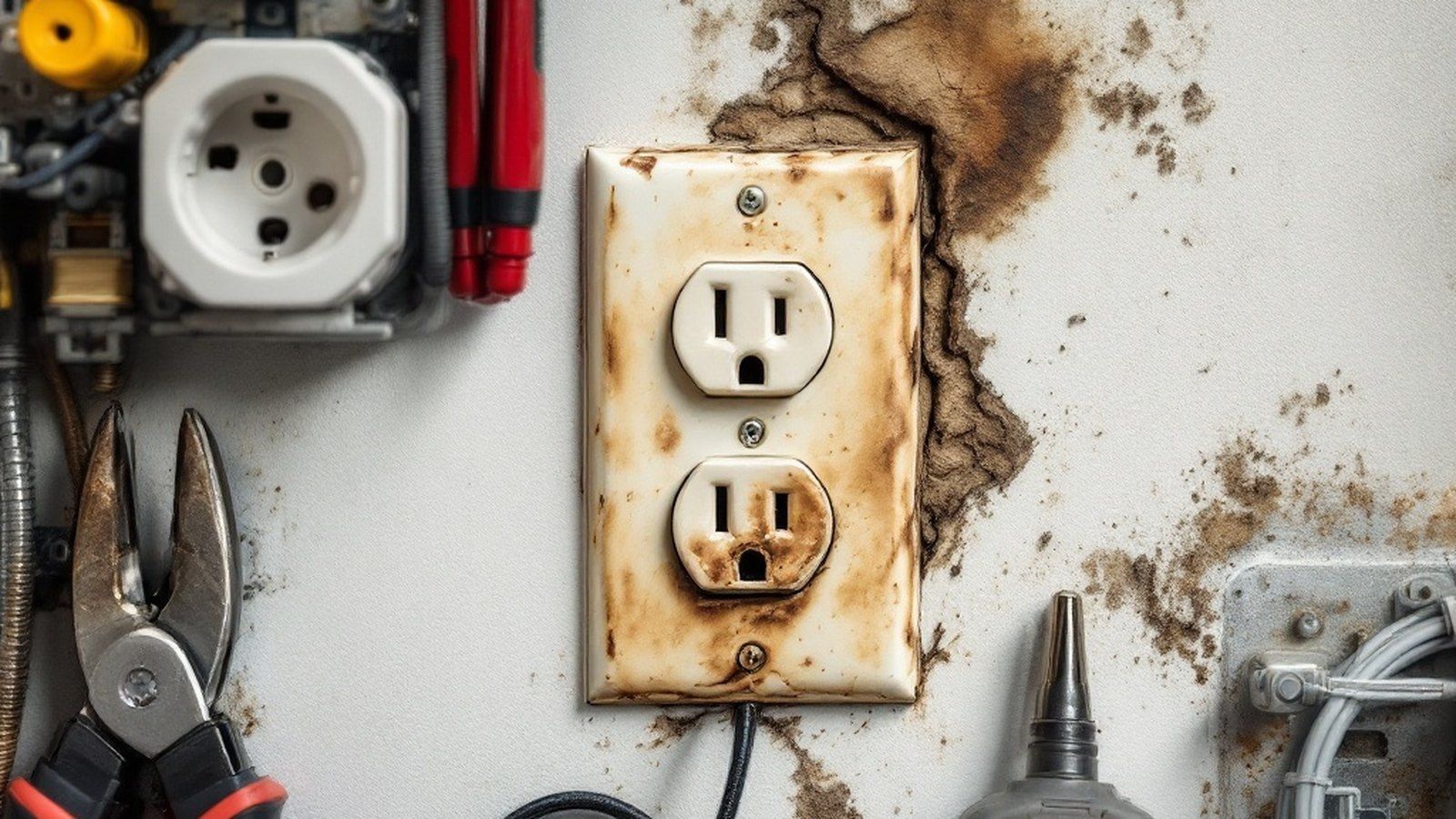
Warm or discolored outlets. An outlet that's warm to the touch — or shows scorching, yellowing, or a melted faceplate — has seen heat it shouldn't have. The likely culprits are a loose connection, an overloaded circuit, or a failing outlet. Stop using it immediately. A discolored outlet is a fire risk, not a nuisance, and it needs an electrician before it goes back into service.
A burning smell. Burning plastic or a sharp "electrical" smell — especially one you can't trace to an appliance — is serious. It often means insulation is melting somewhere inside a wall, junction box, or the panel itself. Turn off the circuit at the breaker. If the smell is coming from the panel, don't touch it: call an electrician and, if you smell smoke or see any sign of fire, call 911. This one has no DIY fix.
Flickering or dimming lights. Occasional flicker when a large appliance kicks on — an AC compressor, a well pump — is usually harmless; it's voltage momentarily dipping under load. Flickering that's random, persistent, or affects multiple rooms is different. That pattern points to a loose connection somewhere in the circuit, at the panel, or on the utility side. A breaker that trips repeatedly on the same circuit is a related signal worth taking seriously.
Buzzing or crackling sounds. A healthy circuit is silent. Buzzing from a switch or outlet usually means a loose wire or a failing device — arcing at a bad connection. Crackling that comes and goes is worse; it can indicate an arc fault condition, exactly the hazard AFCI breakers are designed to catch. Either way, stop using the outlet or switch and have it inspected.
Repeated breaker trips. A breaker that trips once after you plug in too many things is doing its job. One that trips repeatedly on a normal load, or that won't hold after you reset it, is telling you there's a fault — an overload, a short, or a ground fault — that won't resolve on its own.
Any of these symptoms can escalate quickly. The rule of thumb: if a symptom is recurring, spreading, or accompanied by heat or smell, stop using the circuit and get a licensed electrician in. Electrical problems don't improve with time.
Anything inside the panel, a new circuit, or a fault you can't explain belongs to a licensed electrician — there's no shame in making the call.