What You're Looking At
The breaker panel — also called the load center or electrical panel — is the nerve center of your home's electrical system. It receives power from the utility at the main breaker, then distributes it outward through individual branch-circuit breakers, one per circuit. Open the door and you'll see rows of switches, each controlling a slice of your house: the kitchen, the master bedroom, the water heater.
The main breaker sits at the top (or occasionally the bottom) of the panel. It's a double-pole breaker — usually rated 100, 150, or 200 amps — and it controls the entire panel at once. Flipping it off kills power to every branch circuit below it. The utility feed that lands above the main breaker, however, remains live regardless; those wires inside the top of the panel always carry full voltage, which is why working inside your panel is not DIY territory.
Below the main breaker are the branch circuits. Single-pole breakers occupy one slot and supply 120-volt circuits — lights, receptacles, small appliances. They're typically rated 15 or 20 amps. Double-pole breakers span two adjacent slots, tie two legs of the 240-volt supply together, and serve high-draw appliances: dryers, ranges, central air conditioners, electric water heaters, and EV chargers. A 240-volt double-pole breaker's amperage rating is usually marked right on its handle: 30A for a dryer, 50A for a range, and so on. The total amperage of all your branch breakers can exceed your main breaker's rating — that's by design, since not every circuit runs at full load simultaneously.
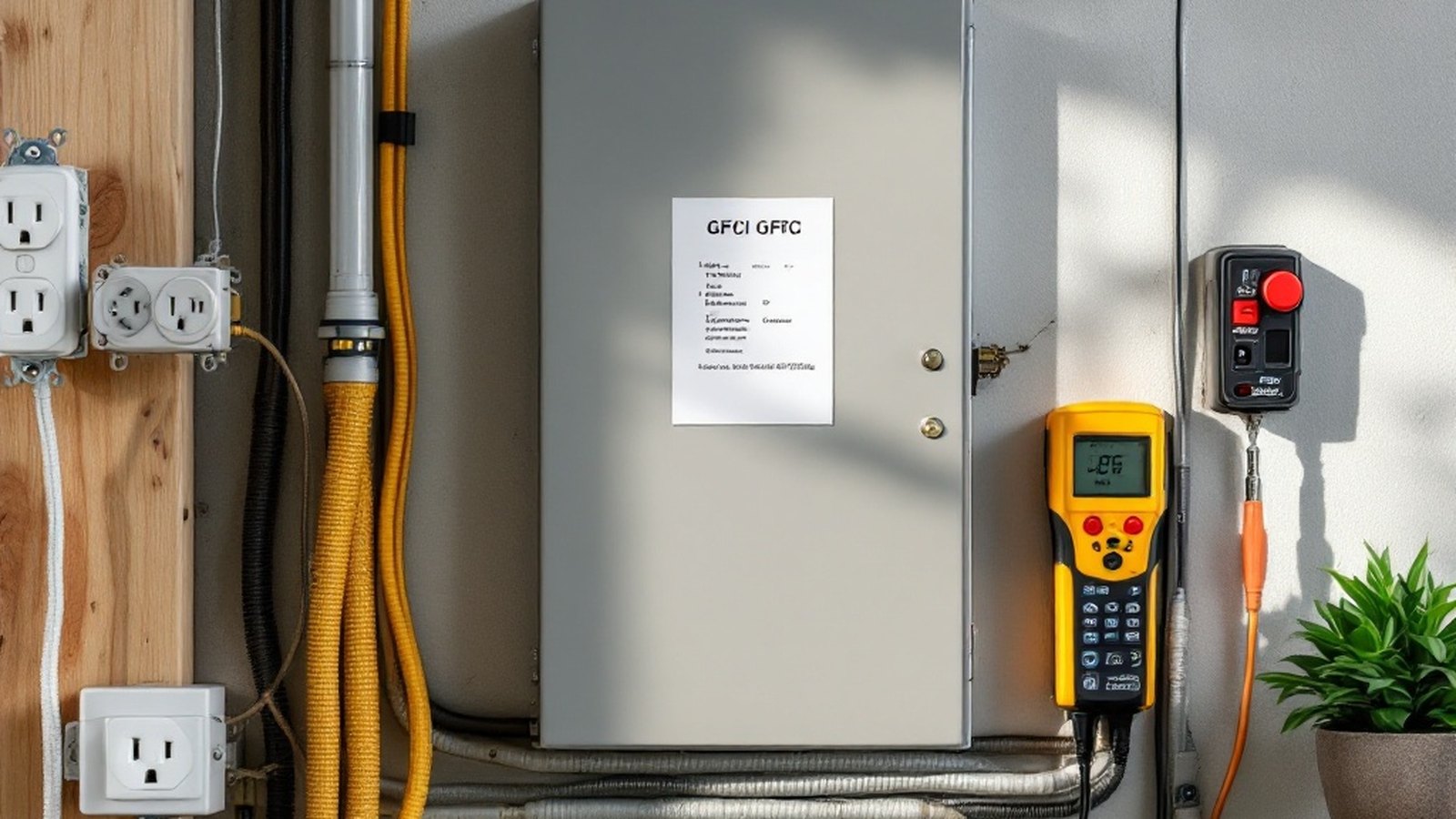
How to Map and Label Your Panel
A well-labeled panel is a genuine safety asset. In an emergency — a burning smell, a flood, a warning sign you can't ignore — knowing instantly which breaker controls which space saves time and possibly prevents harm. Many older panels have vague or simply wrong labels. Correcting them takes about an hour and a helper.
What you need: a plug-in outlet tester with a light or beeper, a phone or walkie-talkie, and a pencil. You'll work from outside the panel — door open, but hands off the wires and bus bars inside.
Start by photographing the existing directory (the label card on the inside of the door). Then flip one breaker off at a time while your helper moves through the house identifying what lost power — a dead outlet, a lamp that went dark, an appliance that stopped. Call it out, note it, flip the breaker back on, move to the next. For outlets you can't easily test by sight, your plug-in tester makes this efficient: plug it in, trip the breaker, check the lights.
A few mapping tips:
- Kitchens often have multiple dedicated circuits — countertop receptacles typically run on two separate 20-amp circuits, the refrigerator may have its own, and the dishwasher usually does too.
- Bathrooms may share a single circuit across multiple rooms, or each may be separate — mapping tells you which.
- Garage, outdoor, and basement receptacles sometimes share a circuit with one another even when they feel remote; they may also share a GFCI protection chain, meaning one GFCI outlet protects several downstream receptacles.
- Double-pole breakers serve one appliance each — label them clearly (e.g., "Dryer," "Central A/C," "Range").
When you're done, fill in the directory card neatly in pen. Many hardware stores sell replacement label cards if the original is illegible.
The Line You Don't Cross
Everything described above — reading the panel, testing breakers, labeling circuits — happens outside the enclosure, with hands away from the interior wiring. That's the safe zone. The work that belongs to a licensed electrician begins the moment any task requires touching wires, terminals, or bus bars inside the panel:
- Adding or replacing a breaker
- Upgrading panel capacity
- Installing a whole-house surge protector at the panel
- Addressing a double-tapped breaker (two wires on one breaker terminal — a common defect worth having an electrician fix)
- Any work on the service entrance or the utility feed
The reason isn't arbitrary caution. Even with the main breaker switched off, the service entrance conductors at the top of the panel stay energized at full line voltage — 240 volts — from the utility. There is no safe way for a homeowner to de-energize them. Only the utility can do that.
If your panel feels warm, smells of burning, makes crackling or buzzing sounds, or if breakers trip repeatedly on a circuit with no obvious overload, those are signs for a licensed electrician, not a DIY session. You don't need to understand every wire in the box to use the panel safely and confidently — you just need to know where your side of the line is.
Anything inside the panel, a new circuit, or a fault you can't explain belongs to a licensed electrician — there's no shame in making the call.