Surge protection is sold in two fundamentally different forms, and the choice isn't either/or. A whole-house surge protector, installed at your main panel, and a quality point-of-use surge strip, plugged in at your TV or computer, do different jobs. Together they form a layered defense that neither one can replicate alone.
What Each Layer Actually Does
A whole-house surge protector — properly called a Type 1 or Type 2 SPD (surge protective device) — mounts at or near your electrical panel and connects directly to the service entrance. When a large surge arrives, typically from a lightning strike nearby or a utility switching event, this device catches the bulk of the energy before it can travel through your home's branch circuits. It handles the heavy lifting: we're talking surges that can carry thousands of volts and thousands of amps, far beyond what any power strip could absorb without failing. The whole-house unit clamps that spike hard, reducing it to a level the rest of your wiring can tolerate.
What it cannot do is eliminate the surge entirely. A whole-house protector is a blunt instrument by design — built for scale, not precision. After it does its work, a residual surge of perhaps 400–600 volts can still ride the line into your home. That's not enough to fry your wiring or trip a breaker, but it is enough to shorten the life of the microprocessor inside a refrigerator, stress-test the power supply in your computer, or slowly degrade the circuitry in a flat-panel TV. That's where point-of-use protection picks up.
A point-of-use surge protector — a quality power strip or a wall-outlet surge adapter — sits right at the device it's protecting and catches what the whole-house unit left behind. Because it's handling a smaller, already-clamped signal, it can use tighter, more sensitive components to clamp even more precisely: a good strip gets the voltage down to the 120–330 volt range that sensitive electronics can actually handle safely. It is the fine filter after the coarse one.
The analogy is simple: the whole-house unit is the levee that stops the flood; the point-of-use strip is the French drain that handles what seeps through.
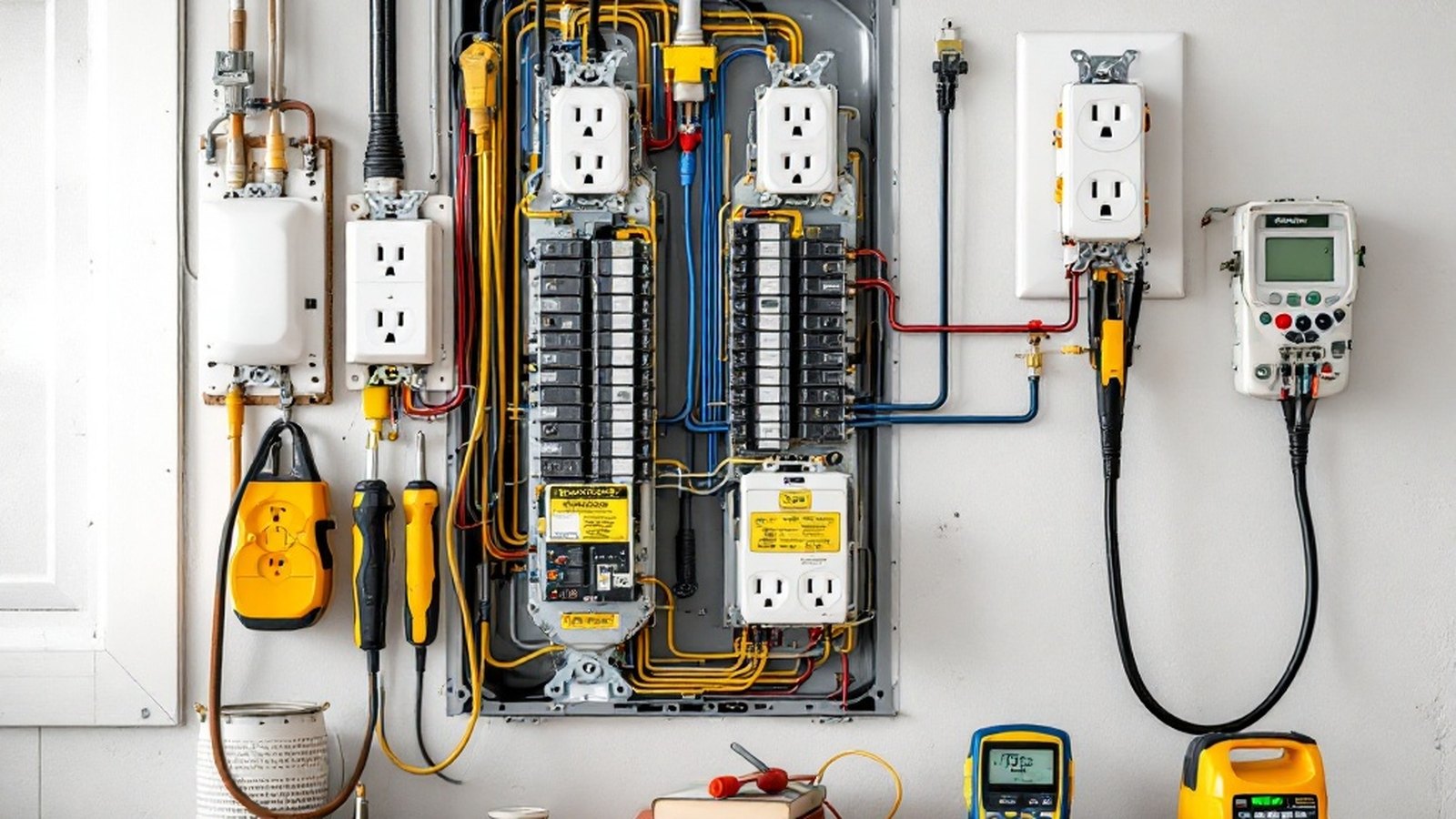
Why You Need Both — and What Happens Without One
Run only a whole-house protector and you're leaving your electronics exposed to the residual surge that rides through after every spike. The whole-house device also won't help against surges that originate inside your home — a motor-driven appliance like an air conditioner or refrigerator cycling on and off generates small voltage spikes on the circuit every time. These internal surges bypass the panel unit entirely; only a point-of-use protector at the device catches them.
Run only a point-of-use strip and you're asking a small device to absorb a massive direct hit. Surge strips are rated in joules — a measure of how much energy the internal MOV (metal oxide varistor) can absorb before it sacrifices itself. A direct or near-direct lightning-induced surge can overwhelm that rating instantly, destroying the strip (and sometimes the equipment behind it) even when the indicator light is still green. The MOV in a quality surge protector works by clamping voltage through a sacrificial component — it can only take so much before it's spent.
Used together, the whole-house unit absorbs the bulk of any external surge, and the point-of-use strip handles the remainder within its comfortable operating range. Neither device is stressed beyond its design limits.
Choosing and Installing the Two Layers
For the whole-house unit, installation means connecting directly to the panel — that's licensed-electrician territory, full stop. The device itself typically mounts in or beside the panel, and the leads connect to the bus bars. Have your electrician specify a Type 2 SPD with a clamping voltage at or below 400V and a surge current rating of at least 40,000 amps (40 kA). Look for UL 1449 listing, the relevant safety standard.
For point-of-use protection, you can install it yourself — it's just a plug. The key specs to look for: a joule rating of at least 1,000–1,500 joules for general use, 2,000-plus for home theater or computer equipment; a clamping voltage of 400V or lower (330V is better); and the UL 1449 listing. A strip that lacks those numbers on the packaging isn't a surge protector — it's a glorified extension cord. Pay particular attention to home office and entertainment equipment, HVAC control boards, and anything with a microprocessor.
One honest caveat: neither layer protects against a direct lightning strike to your home. That's a different magnitude entirely. For genuine lightning country, whole-house protection combined with the habit of unplugging sensitive electronics during storms is still the most reliable approach.
Two layers, clearly understood, correctly specified — that's protection that actually works.
Anything inside the panel, a new circuit, or a fault you can't explain belongs to a licensed electrician — there's no shame in making the call.
Referenced throughout: UL (Underwriters Laboratories) — the independent safety-testing and certification organization whose UL 1449 standard covers surge protective devices.